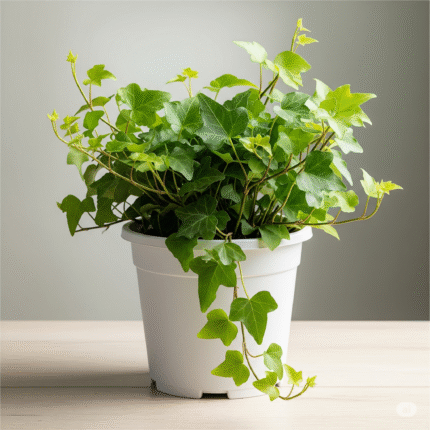

Product Description:
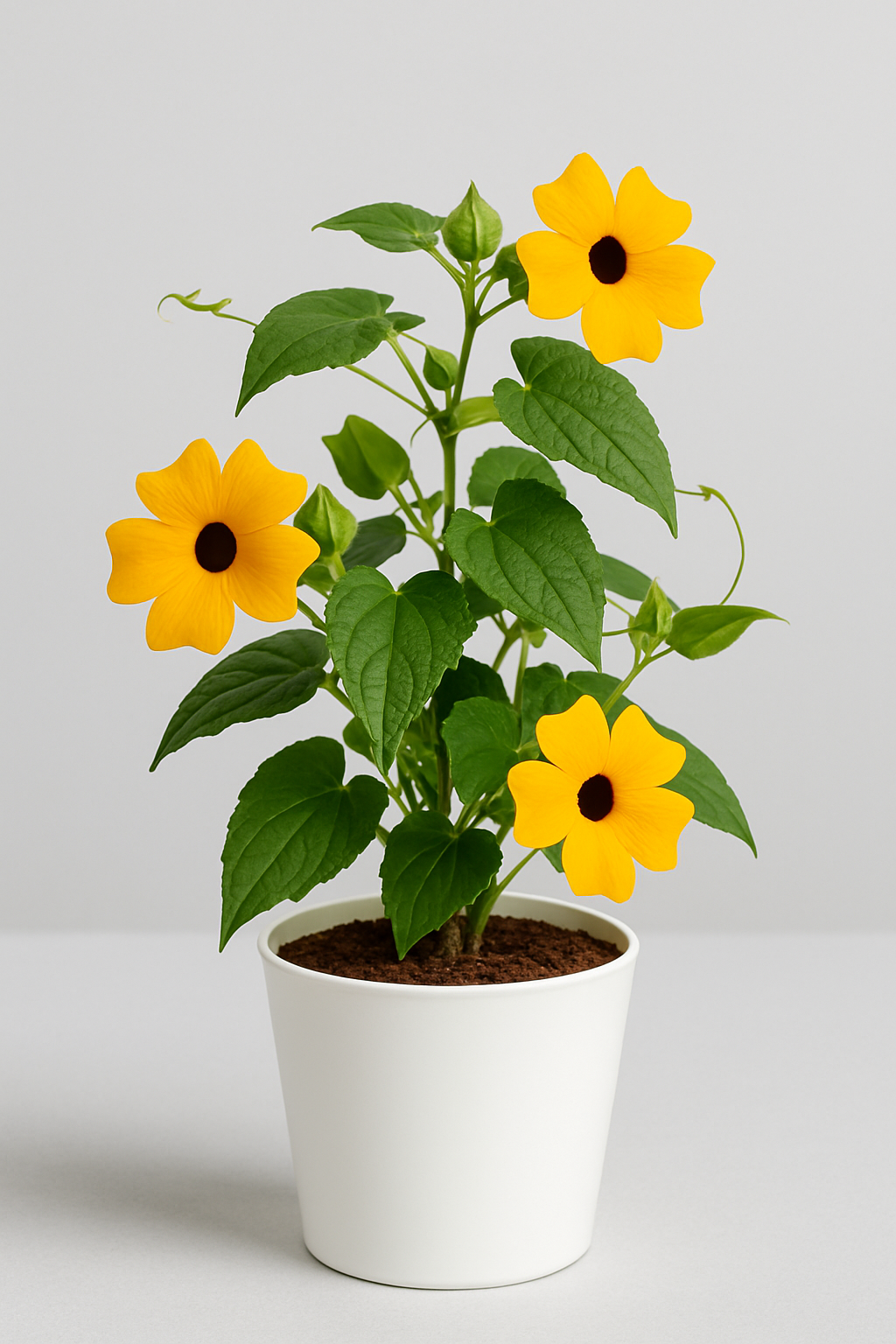
You’re going to love growing Thunbergia vines. Also called Black-Eyed Susan vines, they are native to Eastern Africa. This climber has become naturalized all over the world. It produces an attractive, profusion of daisy-like flowers. Thunbergia flower colors include colors of orange, pale yellow, and white. It is a frequent sight in hanging baskets at the garden center. This flowering vine is as easy to care for as it is charming. It can extend to 8 feet in one growing season. If grown as a perennial in a warm climate.
Light:
You will get the most flowers and the healthiest plants if you grow your black-eyed Susan vines in full sun (at least six hours of direct sunlight on most days).
Soil:
Black-eyed Susan vines like a well-draining soil that is rich in organic matter with a fairly neutral soil ph. It can be helpful to work several inches of compost into the soil before planting.
Water:
Although these vines don’t like sitting in soggy soil, they also don’t like being hot and dry. Aim to keep the soil moderately moist. Mulching around the base of the plants will help to keep the roots cool and moist.
Temperature and Humidity:
Black-eyed Susan vines are reliably perennial only in USDA hardiness zones 10 to 11. Thus, in cooler areas, they are usually grown as annuals (removed from the garden after one growing season). But because black-eyed Susan vines are technically perennials, you can put them in a container and bring them indoors for the winter if you’re outside of the recognized hardiness zones. Black-eyed Susan vines grown indoors may flower in the winter if they get ample sun and the temperature doesn’t fall below 60 degrees Fahrenheit.
Humidity is usually not an issue for these plants, but they can struggle in very dry conditions, so make sure the soil remains moist.
Fertilizer:
Black-eyed Susan vines grow quickly and bloom repeatedly throughout the summer. That means they exert a lot of energy. So they will need a light feeding every four to six weeks with a complete fertilizer to keep them growing well.
Pruning:
Virtually no pruning—not even deadheading—is required for these plants. If you are growing the plant as an annual, simply pull the plant from the ground or pot at the end of the season and discard it. Seeds have a tendency to persist if plants are added to compost heaps.
Propagating Black-Eyed Susan Vine:
There are many ways to propagate black-eyed Susan vine, but the most common is by taking stem cuttings to root.
- In fall while the plant is still actively growing, snip 4- to 6-inch segments of healthy stem, making the cut just below a stem node.
- Plant the cutting in a small container filled with ordinary potting mix. No covering is required.
- Set the pot in a bright, warm location, such as a sunny window, to grow over the winter.
- In the spring after outdoor temperatures are reliably above 60 degrees Fahrenheit, the root cutting, now showing active growth, can be transplanted into the garden or into outdoor containers.